Ottawa sits on the traditional land of the Algonquins, part of the Anishinaabeg, a culturally related group of Indigenous peoples in the Great Lakes region of Canada and the United States.
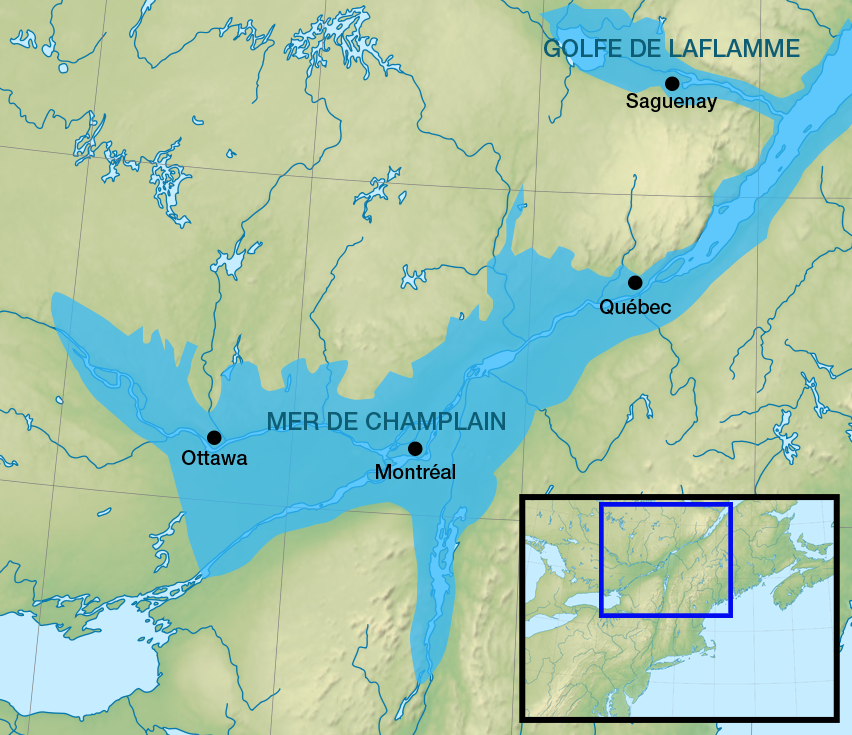
The Ottawa Valley was once covered by the Laurentide Ice Sheet, which began retreating around 15,000 years ago. As the ice melted, water from the Atlantic Ocean flooded the valley, forming the Champlain Sea. Over time, as the Earth’s crust adjusted, the sea drained, allowing the Ottawa River to expand, fed by freshwater from the Great Lakes.
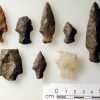
Archaeological discoveries of arrowheads, tools, and pottery suggest a long history of foraging, hunting, fishing, trade, and travel, made possible by the convergence of three major rivers: the Ottawa, Gatineau (which becomes La Pêche), and Rideau.
Before European settlers arrived, the area now known as Ottawa was inhabited by the Algonquin peoples, part of the larger Anishinaabeg group. The Algonquin had a strong connection to the land, using the Ottawa River as a major trade route and for transportation. The river played a vital role in their economy, and the region was known for its rich resources, including fish, wildlife, and fertile land for agriculture.

The name Ottawa is from adawe or atawa which means to “to trade” or “to buy and sell” in several Algonquain languages, including Algonquin, Ojibwa and Cree.
1610 – Étienne Brûlé became the first documented European to navigate the Ottawa River en route to the Great Lakes.
1613 – Samuel de Champlain recorded descriptions of the area's waterfalls and his encounters with the Algonquin people.
1800 – New Englander Philemon Wright founded "Wrightsville" (now Hull) across the river from present-day Ottawa. This was the area's first non-Indigenous settlement, originally a lumber town consisting of five families and twenty-five laborers. Wright pioneered the Ottawa Valley timber trade, transporting lumber by river to Quebec City.
1826 – Land speculators established a community on the south side of the Ottawa River following news of the Rideau Canal’s construction.
1827 – The town was named after Colonel John By, who oversaw the entire Rideau Waterway construction project.
During the early 19th century, the city’s development was driven primarily by the construction of the Rideau Canal and the timber trade. While the Algonquin people and other Indigenous groups once controlled the river and land, their claims were disregarded by the government of Lower Canada, resulting in their loss of territory.
1832 – The Rideau Canal was completed, and Bytown’s population grew to 1,000.
1835–1845 – Irish labor unrest led to the Shiners' War.
As the Rideau Canal neared completion, French Canadian and Irish Catholic workers struggled to find new employment. This led to the formation of gangs that attacked timber operations and political institutions, culminating in the Shiners’ War. The conflict was between French Canadians, who dominated the lumber industry, and Irish Catholics, who were left unemployed after the canal’s completion.
Ottawa was incorporated in 1855. Before that, it was known as Bytown, named after Colonel John By, who was sent by the British in 1826 to design and construct the Rideau Canal, linking present-day Ottawa to Lake Ontario and the St. Lawrence River at Kingston.
Before the canal’s construction, the Ottawa River Valley was sparsely populated. A settlement was established to house workmen and labourers, later named after Colonel By. Bytown was divided into two sections: Upper Town (west) and Lower Town (east).
Lower Town was home to French Canadians and Irish Catholic immigrants, who worked in the dangerous construction of the Rideau Canal. Upper Town was where English and Scottish residents lived and acted as the town’s self-appointed governors.
1842 - Vote rejects Kingston as capital and Bytown was on the list of potential candidates, even though it was less popular than Toronto or Montreal. 1843- Report of the Executive Council recommended Montreal, however the governor general refused to move without a parliamentary vote. 1844 - The Queen accepted a parliamentary vote and moved the capital to Montreal.
Originally the governor general of the province designated Kingston as the capital in 1841, however, the major population centres of Toronto and Montreal along with the former capital of Lower Canada, Quebec City all had legislators dissatisfied with this decision.
1849 - Stony Monday Riot
Canadian Parliament was located in Montreal and Lord Elgin was signing the Rebellion Losses Bill which would compensate Lower Canadians for losses suffered during the Rebellions of 1837-38. The bill was unpopular with Loyalists as it compensated those who participated in the rebellion unless convicted of treason. Riots ensued in Montreal, Lord Elgin was assaulted and the Parliament buildings were burned.
Lord Elgin announced that he was considering relocating the nation’s capital and organised a visit to Bytown. Loyalists, (Tories) including the mayor Robert Hervey opposed organising a reception for Lord Elgin, and at a meeting to plan the visit organised by Reformists the two sides clashed, first with sticks and stones and later with firearms.
Two days later the two political factions, armed with cannons, muskets and pistols faced off on the Sappers Bridge over the Rideau Canal. The military arrived in time to defuse the situation but Lord Elgin delayed the visit until 1853.
1850s- Entrepreneurs known as lumber barons began constructing large sawmills, becoming some of the largest mills in the world.
1850 - Bytown was incorporated as a town
1854 - Rail lines connected Ottawa to areas south and from 1886, to the transcontinental rail network via Hull and Lachute, Quebec.
1855 - The name "Ottawa" was chosen and officially incorporated as the "City of Ottawa"
1856 - Vote passed for the lower house of parliament to relocate permanently to Quebec city. But the upper house refused to approve funding. This led to the ending of legislatures role in determining the seat of government and the Queen was requested to make the decision.
1859 - The Queen selected the recently renamed Ottawa after taking advice from her governor general and this choice was ratified by Parliament in 1859, with Quebec serving as the interim capital from 1859-1865.
Ottawa was chosen as the capital for two main reasons, it was an isolated location on a cliff face surrounded by dense forest far from the Canada-US border and was also a political compromise as it is midway between Toronto and Kingston (Canada West) and Montreal and Quebec City (Canada East).
1865 - The relocation process began, and the first session of Parliament was held in the new buildings in 1866.
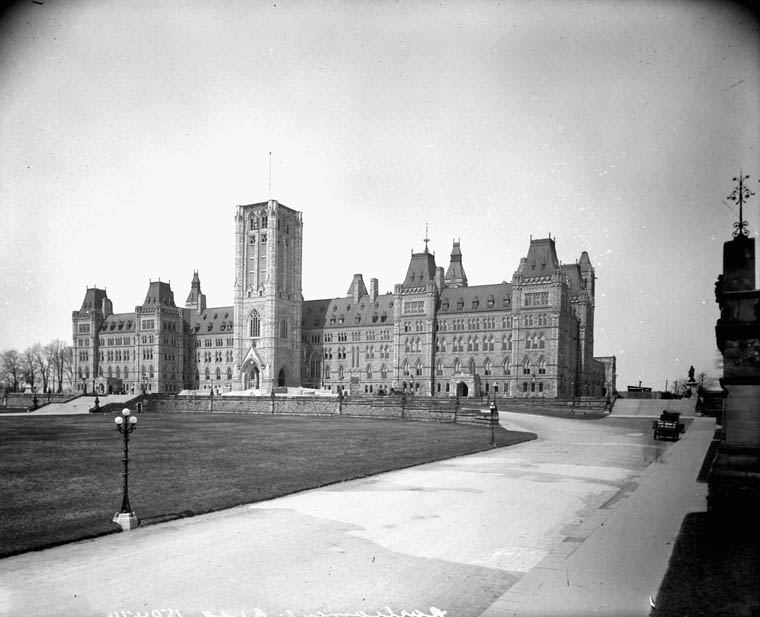
1859-1866 - Construction of the original parliament buildings (the entre, East and West Blocks) in the Gothic Revival style, which at the time was the largest North American construction project.
1876 - The Library of Parliament and Parliament Hill landscaping was completed.
1889 - Government developed and distributed 60 “water leases” (still in use) to local industrialists which gave them permission to generate electricity and operate hydroelectric generators at Chaudiere Falls.
1870 - Public transportation began with horsecar system
1890s - Vast electric streetcar system operated until 1959.
1900 - Hull-Ottawa fire destroyed two-thirds of Hull and one-fifth of Ottawa buildings.
1912 - Grand Trunk Railway opened Chateau Laurier hotel and its neighbouring downtown Union Station.
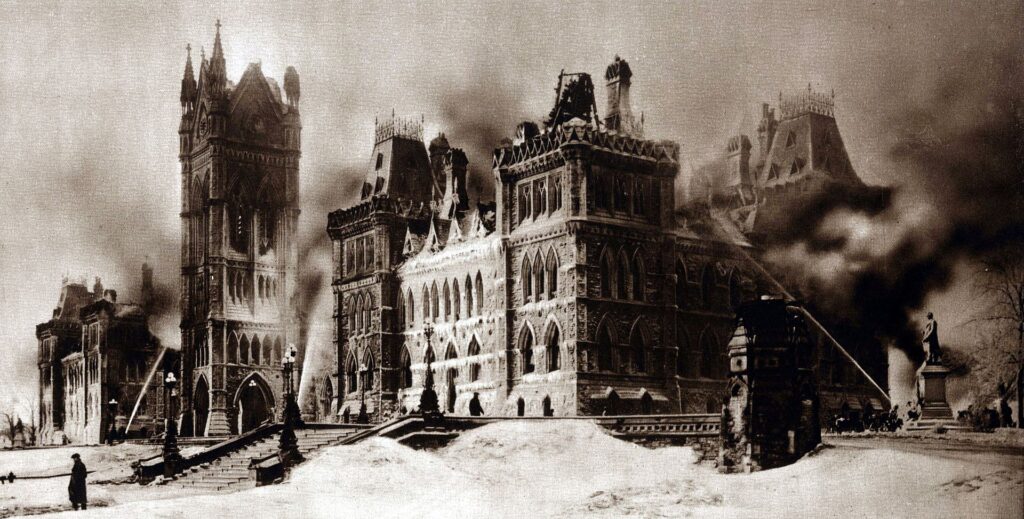
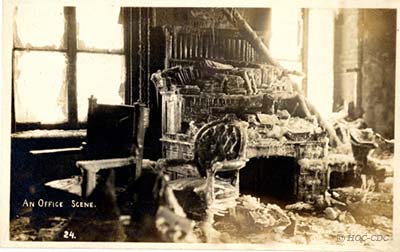
1916 - Centre Block of Parliament buildings was destroyed by a fire and forced a temporary relocation of the House of Commons and the Senate until the completion of the new Centre Block in 1922. The Peace Tower was now the centrepiece of the new Parliament Buildings.
1950 - Prime Minister Mackenzie King hired French architect-planner Jacques Greber to design an urban plan for managing development in the National Capital region in an attempt to make it more aesthetically pleasing and more befitting for Canada’s political centre.
The Greber Plan included creating the National Capital Greenbelt, the Parkway and the Queensway highway system, while also moving the downtown Union Station, removing the street car system, decentralisation of selected government offices, relocation of industries and removal of substandard housing from downtown, and creating the Rideau Canal and Ottawa River pathways.
1958 - National Capital Commission was established as Crown Corporation through the National Capital Act with the mission to implement the Greber Plan. This meant there was now a permanent political infrastructure for managing the capital region.
1960s-1980s - large increase in construction in the National Capital Region.
1900-2000s - Large growth in high-tech industry, and Ottawa became one of Canada’s largest high-tech cities and was nicknamed Silicon Valley North.
1991 - Provincial and federal governments responded to a land claim submitted by the Algonquins of Ontario regarding the unceded status of the land Ottawa sits on.
There are ongoing negotiations with an eventual goal to sign a treaty that would release Canada from claims for misuse of land under Algonquin title while affirming various rights of the Algonquins and negotiate other conditions for this title transfer.
2001 - City limits have been increasing over the years but acquired the most territory in 2001 when it amalgamated all the municipalities of the Regional Municipality of Ottawa-Carleton into one city.
This year also saw the introduction of a diesel-powered light rail transit on an experimental basis. Today it is known as the Trillium Line, but it was originally called the O-Train, which connected downtown Ottawa to the southern suburbs via Carleton University.
2006 - Decision to extend the O-Train and to replace it with an electric light rail system was a major issue in the municipal elections.
After Larry O’Brien was elected as Ottawa mayor the transit plans were changed to establish a series of light rail stations form the east side of the city into downtown, using a tunnel through the downtown core.
2012 - City council approved final Lansdowne Park plan in an agreement with the Ottawa Sports and Entertainment Group that consists of a new stadium, increased green space and housing and retail added to the site. City council also voted to approve the Confederation Line, an extension of the light rail transit.
2019 - Confederation line which is 12.5 km of light rail transit opened on September 14